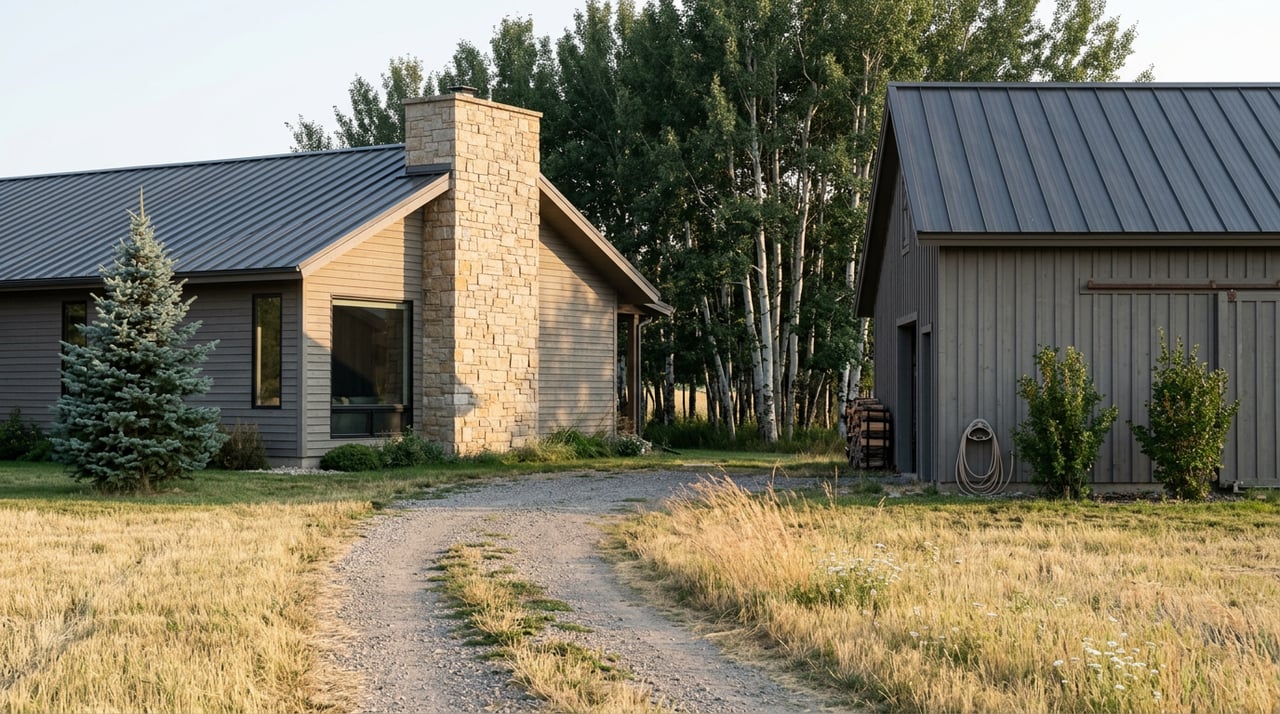
In April 2026, Woody Creek recorded zero home sales. Not a slow month by the standards of Aspen or Snowmass Village, where a dozen closings might quietly become eight. Zero. A year earlier, in April 2025, the neighborhood's median home price had stood at $27 million. There was nothing to measure it against in 2026, because nothing sold.
Five weeks later, the silence broke. On May 18, a single transaction closed at 725 & TBD Aspen Valley Downs Road for $24.65 million, or $2,803 a square foot. One sale, one address, and a number large enough to reset the neighborhood's entire monthly average.
Anywhere else, that swing would look like a market in crisis. In Woody Creek, it is simply how the math works when a handful of transactions a year have to carry the weight of a median. And once you understand why the transaction count stays so thin, the rest of Woody Creek's pricing starts to make a different kind of sense. This is a market where the acre, not the square foot, is the unit that actually gets priced.
The zoning line that explains the silence
Most of Woody Creek sits outside the urban growth boundaries Pitkin County has drawn around Aspen and Basalt. Outside those boundaries, the county's land use code steers development toward large lots on purpose. A meaningful share of the ground here falls under zoning that requires a minimum of 35 acres per residential lot, some of it carrying the county's Rural and Remote designation, created in 1996 specifically to cap growth in backcountry areas with limited access to emergency services and utilities. Under that designation, a cabin cannot exceed 1,000 square feet of floor area. Other 35-acre-minimum districts allow considerably more house, which is part of why Woody Creek listings range from modest cabins to 12,000-square-foot estates on the same kind of acreage.
You can read the actual dimensional standards in Pitkin County's land use code, but the practical effect for a buyer is simple: this land was never going to subdivide into a normal neighborhood of normal lots, because the county wrote the rule to prevent that outcome. Fewer buildable parcels means fewer transactions in any given year, which means any single sale, especially a $24.65 million one, can swing the median by millions.
A few pockets break the pattern, and they're worth knowing about before you assume every Woody Creek listing sits on 35 acres:
- Aspen Village Subdivision, Lazy Glen Subdivision, and the Woody Creek Subdivision itself operate under their own, older development guides rather than the county's current acreage minimums, which is why you'll occasionally see a compact home or a manufactured home in the mix alongside the ranches.
- Some parcels predate the 1996 rule entirely and were never required to meet it.
That's the reason a five-bedroom ranch on 4.3 acres, recently listed at $7.5 million, can sit in the same search results as a 111-acre parcel. They aren't the same product, even though a portal search lumps them together under one neighborhood name.
Priced by the acre, not the square foot
By July 2026, the median list price across Woody Creek's active inventory had climbed to $14.2 million, with homes spending a median of 35 days on market, seven percent faster than the same month in 2025. Active listings that month ranged from roughly $6 million to $30.9 million, with a median asking price of $2,534 per square foot.
As of late May 2026, the dozen homes actively listed in the neighborhood averaged 5,804 square feet, close to 70 percent larger than the typical home elsewhere in Pitkin County, and asked an average of $8.69 million. Square footage explains part of that number. It does not explain most of it.
The land does. In November 2025, four vacant lots totaling 111 acres inside the Aspen Valley Downs subdivision sold for $25 million, which works out to roughly $225,000 an acre for raw, unimproved ground. Compare that to the $7.5 million asking price on that 4.3-acre developed ranch, which pencils out closer to $1.7 million an acre once a house, barn, and improvements are on the land. The gap between those two numbers is the actual product being sold in Woody Creek: not the house, but the deeded, zoning-protected acreage underneath it, which cannot be split into smaller resale lots the way a subdivided suburban parcel can.
Here are three recent, publicly documented Woody Creek properties:
| Property | Date | Price | Detail |
|---|---|---|---|
| 725 & TBD Aspen Valley Downs Rd | May 18, 2026 | $24.65M | $2,803 per square foot |
| Aspen Valley Downs, 4 vacant lots | Nov 24, 2025 | $25M | 111 acres, no structure |
| Ranch, 4.3 acres, 5 bed / 4.5 bath | Listed spring 2026 | $7.5M | Improved parcel |
Three properties at three different price points, all inside the same zip code. That spread is the clearest evidence that a single median figure tells you almost nothing about what a specific Woody Creek property is worth.
What the same money buys ten minutes down the road
For a buyer cross-shopping Woody Creek against Aspen proper, the comparison gets more interesting than the headline numbers suggest. In May 2026, Aspen recorded six single-family home sales, down from nine a year earlier, with the median home price falling from $14 million to $4.6 million, a 67 percent year-over-year drop driven mostly by which specific homes happened to close that month. Aspen's condo market moved the opposite direction over the same stretch, with the median condo price climbing from $1.9 million to $3.85 million.
Set that $4.6 million median sold price for an Aspen single-family home against Woody Creek's $14.2 million median list price two months later, and the difference isn't really about house size or finish level. It's about what's attached to the deed. In Aspen proper, a buyer is largely paying for walkable proximity to town, restaurants, and the gondola. In Woody Creek, that $14.2 million median list price reflects a different proposition: distance from all of that, plus a legal guarantee, backed by county zoning, that no one can carve the surrounding land into a subdivision next door.
Neither trade is objectively better. They're different products wearing the same regional label, and a buyer who assumes Woody Creek is just "Aspen, but with a yard" will misprice the offer they submit.
The trade a buyer is actually making
None of this means Woody Creek is remote in the way the zoning code's name suggests. RFTA runs a local route between Woody Creek and both Aspen and Snowmass Village with free fares, using the Brush Creek Park & Ride as a transfer hub, which lets a second-home owner leave a car in the garage for weeks at a time. The Rio Grande Trail runs along the edge of the community for anyone who'd rather bike into town than drive. Woody Creek Tavern, the community's most recognizable landmark, still anchors the neighborhood's social life the way it has for decades. None of that shows up in a median-price calculation, but it's part of what a buyer is weighing against the zoning math above.
What the zoning does guarantee is that the trade stays stable over time. A buyer paying $225,000 an acre for raw Aspen Valley Downs land in 2025, or $2,803 a square foot for a finished estate in 2026, isn't betting on density arriving later to justify the price. Pitkin County's code was written to make sure it won't. That's a different kind of certainty than square-footage pricing offers, and it's the reason serious acreage buyers treat a thin, volatile transaction count as a feature of this market rather than a warning sign.
A few questions that come up often
Can a 35-acre Woody Creek parcel ever be subdivided into smaller lots later? Not under the county's current code. The Rural and Remote and 35-acre resource districts were written specifically to prevent that kind of future subdivision, so acreage purchased today stays intact acreage.
Why do some Woody Creek listings sit on far less than 35 acres? A handful of older subdivisions, including Aspen Village, Lazy Glen, and the Woody Creek Subdivision itself, are governed by their own development guides rather than the county's current acreage minimums, and some parcels simply predate the 1996 rule.
Is it realistic to live in Woody Creek without keeping a car at the property? RFTA's Woody Creek route offers free fares to Aspen and Snowmass Village, with the Brush Creek Park & Ride serving as a transfer point, which some part-time owners rely on between visits.
If you're weighing a Woody Creek parcel against something closer to town, the number that matters most rarely shows up on the listing sheet. Mary Kate Farrell spends her time in exactly this kind of zoning and comp detail so her clients don't have to guess at it. Let's Connect.
This article is general information, not legal, tax or financial advice. Consult a qualified professional about your situation.